Why Your Best Leaders Are Burning Out (And What Most Organizations Get Wrong About It)

The director walks into another back-to-back day of meetings feeling scattered before it even begins. He's interrupting more. Asking fewer questions. Making quick decisions that need rework later. Under his desk, his leg bounces, a “tell” he doesn't notice anymore.
His team mirrors him quietly. Short tempers. Urgency as the default setting. Limited reflection. Everyone moving fast, but nothing feels like it's moving forward. Just “busyness.”
This isn't a story about one person's struggle with time management. It's a story about what happens when leaders operate in survival mode and entire systems reflect the same.
The Problem We Keep Misdiagnosing
You've seen the data. Engagement scores dropping, talented leaders leaving, burnout becoming the norm, not the exception.
So you respond. You add wellness apps, mental health coaching, mindfulness webinars, extended leave options, more ERG support, another listening tour. The utilization numbers look good. People click, attend, and nod...but nothing fundamentally shifts.
Because here's what most organizations get wrong: You're treating systemic, adaptive challenges with technical, individual-level fixes.
Burnout isn't a personal resilience problem. Low engagement isn't a recognition gap. Culture erosion isn't something a new values statement can solve.
These are signals. Your ecosystem is telling you something.
The Real Cost
When we misdiagnose the problem, we create what I call "the regulation tax."
Your highest performers (the ones you can't afford to lose) are spending their finite energy managing dysregulation instead of leading. They're:
- Absorbing unsustainable workloads because systems don't adapt
- Managing their own nervous system responses and their teams' stress responses
- Trying to innovate while operating in survival mode (thinking brain is offline)
- Making decisions from their brainstem, not their prefrontal cortex
Here's the thing about the human brain: regulation precedes reasoning.
When your leaders' nervous systems are constantly signaling threat – through impossible workloads, unclear priorities, or misaligned resources – the part of their brain responsible for strategic thinking, creativity, and collaboration goes offline.
This is not because they're not talented enough. It's not because they need another workshop on resilience. It's because you can't think your way out of a dysregulated nervous system. You have to feel your way back to regulation first. Ooh. Did I just say the “F” word? Yes. FEEL. Hear me out.
The Reframe: From Machines to Living Systems
What if I told you that your organization isn't broken? What if the issue isn't that your people lack grit, or that your culture initiatives aren't "sticky" enough?
What if the issue is that you're treating your organization like a machine to be fixed when it's actually a living ecosystem that needs the right conditions to thrive?
Organizations, like human beings, are complex adaptive systems. They have a nervous system. They respond to threat and safety. They compensate when one part becomes misaligned. They develop patterns – some healthy, some not – that ripple across every level.
And just like individual nervous systems, organizational ecosystems can get stuck in survival mode.
The Three Levels Where Culture Actually Lives
Your People & Culture ecosystem operates across three interconnected levels. Each one influences the others through feedback loops that either reinforce growth or perpetuate dysfunction.
Individual/Personal Level: The Leader's Nervous System
This is where it starts. How your leaders regulate under pressure shapes everything downstream. When leaders are dysregulated, it shows up as:
- Fight: Interrupting, controlling, micromanaging
- Flight: Avoiding difficult conversations, disappearing into "strategic work"
- Freeze: Decision paralysis, endless analysis
- Fawn: People-pleasing at the expense of boundaries, over-accommodating
Your team doesn't just hear what leaders say. They feel what leaders feel. Mirror neurons are real. Nervous systems attune to one another...for better or worse.
One dysregulated leader creates a dysregulated team.
Collective/Team Level: The Relationship Ecosystem
This is where culture either compounds stress or contains it.
- Maybe collaboration has become excessive – too many meetings, too many stakeholders, blurred accountability. You wanted inclusion, but now no one can move.
- Maybe psychological safety is falling. People stop speaking up. Urgency becomes the excuse for skipping reflection. Conflict gets avoided or weaponized, never constructive.
- Or maybe your teams have normalized behaviors that no one questions anymore: weekend emails as dedication, exhaustion as proof of commitment, boundaries as a lack of team spirit.
These aren't just "team dynamics." They're systemic patterns reinforced by what gets rewarded, what gets ignored, and what gets modeled from the top.
Organizational/Systems Level: The Structural Reality
This is where good intentions meet misaligned systems.
- You say wellbeing matters...but workload keeps surging while resources shrink.
- You say learning matters...but your performance reviews reward output over experimentation.
- You say collaboration matters...but your promotion criteria elevate individual heroics.
The system is always telling the truth – even when leadership messaging says something different. And here's two common feedback loops that keeps organizations stuck:
- Loop 1: Dysregulated leader → stressed team → systems compensate unsustainably → workload increases → leader burns out further → cycle repeats.
- Loop 2: Systems reward output over sustainability → leaders model overwork to advance → teams normalize burnout as commitment → talent leaves → remaining employees absorb more work → systems double down on output metrics → cycle repeats.
Technical fixes can't interrupt those loops. Only adaptive solutions can.
What Healthy Ecosystems Do Differently
Healthy organizations, like healthy nervous systems, adapt and recover.
They notice patterns. They regulate under pressure. They relate through trust. They reflect instead of just react. And they iterate – learning, adjusting, evolving…without blame and shame.
This is what I call the ALCHEMI© approach – a framework that focuses on awareness, regulation, connection, sustainable rhythms, purpose alignment, mindset, and continuous learning. Together, these shape the internal conditions that determine how leaders think, decide, and act under pressure.
The same principles that help individual leaders regulate, relate, and respond are the principles that make organizations resilient.
What Actually Works (And Why You Keep Missing It)
You don't have an individual problem. You don't have a team problem. You don't have a systems problem. You have an ecosystem problem and you've been solving for the wrong level.
Here's what I see happen over and over:
- Leadership notices burnout → offers wellness apps and mental health days (individual fix). But the real issue? Workload tripled after layoffs and no one reprioritized (systems problem)
Or:
- Teams can't execute → send them to collaboration training (collective fix). But the real issue? Decision rights are unclear and leaders are bottlenecking everything (individual + systems problem)
The reason your initiatives don't stick isn't because they're bad ideas. It's because you're applying solutions at the wrong level of the ecosystem. And without diagnostic clarity, without seeing how individual regulation, team dynamics, and organizational systems are interconnected, you'll keep spinning.
The Missing Piece
Most organizations I work with can see the symptoms:
- Engagement scores dropping
- Turnover in key roles
- Wellness programs no one uses
- Teams that can't execute despite talent
But they can't see the feedback loops. They can't identify which level is actually driving the dysfunction or where their real leverage is.
- Is it leaders operating from survival mode whose stress cascades through teams?
- Is it team patterns that have normalized unsustainable behavior?
- Is it systems and structures signaling threat and scarcity?
All three levels influence each other. When one becomes misaligned, the entire system compensates, often unsustainably.
Without that diagnostic lens, you keep solving for the wrong thing.
See Your Ecosystem Clearly
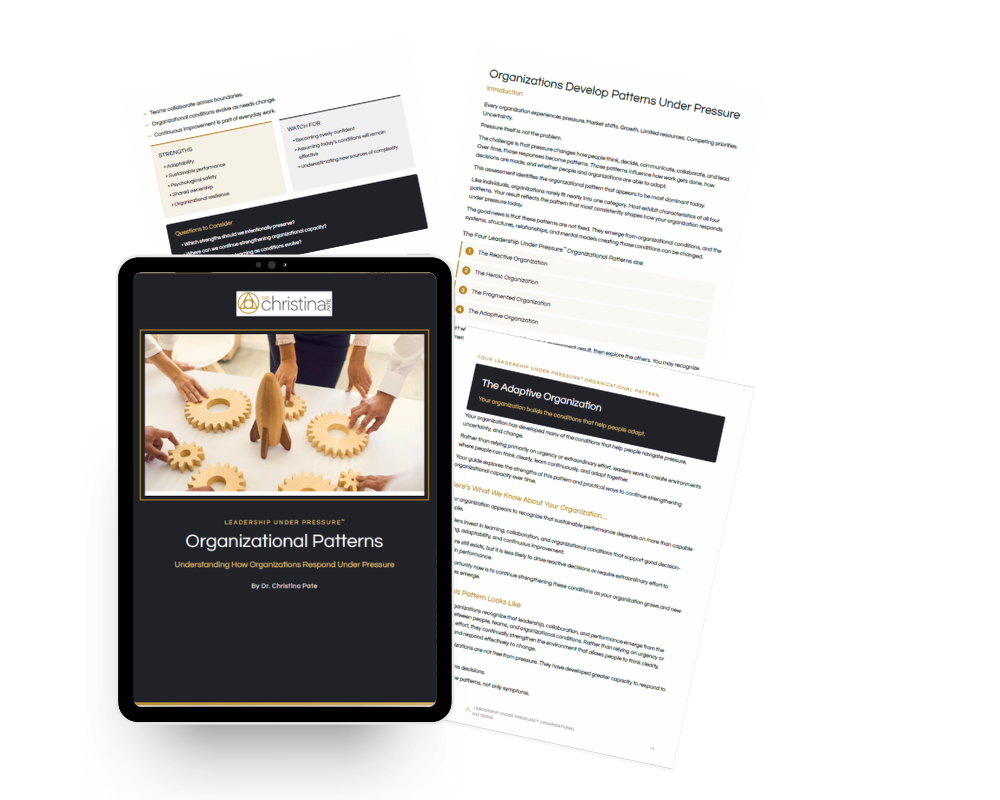
The Understand Your People & Culture Ecosystem Guide gives you what most organizations are missing: a way to see the whole system.
Inside, you'll find:
✓ The three-level diagnostic framework – so you can identify where dysfunction is actually coming from (not just where it's showing up).
✓ Real case examples across individual, team, and organizational levels – including what happened when leaders stopped treating burnout as a personal problem and started addressing the systems driving it.
✓ Reflection prompts for each level—the questions that reveal feedback loops, faulty mental models, and leverage points you've been missing
✓ Action planning tools – so you can intervene at the right level and create ripple effects, not isolated fixes
This isn't another generic culture framework. It's a systems-thinking approach grounded in neuroscience and adaptive leadership designed for the complexity you're navigating.
Download the free Ecosystem Guide here →
Go Deeper: How Stress Responses Shape Everything
Want to understand the individual/leadership level more deeply without blaming individuals for systemic issues?
The Mindsets & Behaviors for Organizational Culture on-demand webinar shows you how stress responses (fight, flight, freeze, fawn) show up in people and why they're often a response to organizational conditions, not personal failure.
You'll learn:
✓ How to recognize when leaders are operating from survival mode and what that signals about your ecosystem
✓ Systems thinking applied to human behavior – how to design conditions that support how people actually function
✓ Why regulation is a leadership capacity, not a personal wellness issue
✓ How to create conditions that enable both performance and wellbeing (they're not trade-offs)
The Truth
You're not going to think your way out of this. You're not going to fix it with another program, another survey, or another listening session. You need to see the system differently. Because performance and wellbeing aren't opposing priorities. They're interdependent outcomes of the same ecosystem.
When you learn to see that ecosystem clearly – when you understand which level is driving the patterns you're trying to fix – you stop spinning and start creating conditions for actual change.
Start seeing what you haven't been able to see.
The breakthrough your organization needs isn't another initiative.
It's the ability to diagnose where the real leverage is.
Next Steps
Download the Ecosystem Guide
Watch the Webinar
Ready for deeper, personalized support? Book a free discovery call with me