You've Built a Great Team. So Why Does Leadership Still Feel So Hard?

There is a particular kind of exhaustion that doesn't show up in job descriptions or leadership development programs. It isn't the exhaustion of managing a difficult team or recovering from a failed initiative. It's the exhaustion of doing everything right and still feeling like you're barely keeping up.
You hired carefully. You built trust over time. You created the conditions for psychological safety. Your team communicates well, produces good work, and actually wants to be there. By most measures, you've done what good leaders are supposed to do.
And yet, leadership still feels like an endurance sport.
You spend significant energy protecting your team from decisions that arrive without warning, priorities that shift mid-stream, and friction that originates somewhere above or beside you in the organizational chart.
The team is strong. The system around it is not. And somewhere in the gap between the two, you're absorbing a weight that isn't entirely yours to carry.
This is one of the least-discussed realities of mid-level and senior leadership, and it is far more common than most organizations are willing to acknowledge.
When the Challenge Isn't Capability
Most leadership development programs are built around a reasonable assumption that when leaders struggle, the answer is more skill. Better communication models. Stronger feedback frameworks. More nuanced approaches to difficult conversations.
For many leaders, that assumption is wrong.
The leaders described above often already know how to communicate. They've had the training. They understand the frameworks. The problem is that knowing how to do something and being able to access that knowledge under sustained organizational pressure are two very different things.
Layered underneath that, there is a second problem that gets named even less often, which is that the system around them doesn't consistently support the behaviors those frameworks require.
People cannot perform consistently in environments that don't support the behaviors being asked of them. This is a structural observation, not a character judgment.
For example, when communication norms break down at the organizational level, when decisions are made without input from the people most affected, and when shared resources are managed through competing priorities rather than clear agreements, individual leadership skill can only travel so far.
The strongest leaders in those environments aren't simply better communicators. They've also learned to distinguish between what belongs to them and what belongs to the system.
The Hidden Cost of Responsibility Without Authority
Here is where the real tension lives.
Many leaders spend years building trust and coherence inside their teams while simultaneously navigating relationships outside their teams that they have limited formal power to influence.
They are accountable for outcomes shaped by decisions they weren't part of. They manage shared resources with units whose priorities don't align with theirs and have no structural leverage to close that gap. They find out about changes after they've already happened.
And they absorb all of it, because the team is watching.
This is the hidden cost of leading between competing systems. The decision fatigue is real. So is the hypervigilance, the low-grade reactivity that builds across weeks and months of navigating ambiguity that never fully resolves.
Leaders in this position often describe feeling more like buffers than strategists. More like interpreters of an unpredictable environment than architects of a clear one.
What makes this particularly difficult is that the coping strategy most leaders reach for is also the one most likely to deepen the problem. If I explain it better. If I stay patient longer. If I absorb more without escalating, things will eventually improve.
Sometimes they do. Often, the system simply generates the same patterns again.
The issue at that point isn't effort. It's leverage. And no amount of additional personal effort changes a structural dynamic that hasn't been examined.
Leadership Happens at Three Levels
Understanding why this pattern persists requires looking at leadership as something that operates across three interconnected levels simultaneously, not just as a set of behaviors a single person performs.
The Leader. Everything starts here, inside the individual carrying the pressure. How a leader is experiencing stress shapes every decision they make, every signal they send, and every dynamic they either stabilize or amplify.
Sustained pressure changes how the brain processes information. It narrows attention, accelerates reactivity, and activates narratives that feel true but often aren't helpful. Narratives like, "if I just explain it clearly enough, they'll respond differently" or, "I should be able to move this forward on my own."
Those narratives tend to generate more friction than traction, especially at the level of organizational complexity where most mid-level leaders are operating.
Awareness of pressure patterns, and the ability to regulate the nervous system response they produce, is foundational to everything else. Clarity and steadiness at the individual level make every downstream intervention more effective.
The Team. From that steadier center, leadership expands outward. A team's sense of psychological safety, its capacity to stay grounded under pressure, its ability to communicate clearly and hold appropriate boundaries, are all shaped significantly by what leaders are modeling, often without realizing it. Teams need their leaders to be steady more than they need their leaders to be perfect. When leaders are absorbing pressure without processing it, teams absorb it too, usually without naming what's happening.
This level focuses on the communication patterns, rhythms, and relational conditions that allow a team to stay functional even when the environment around it isn't.
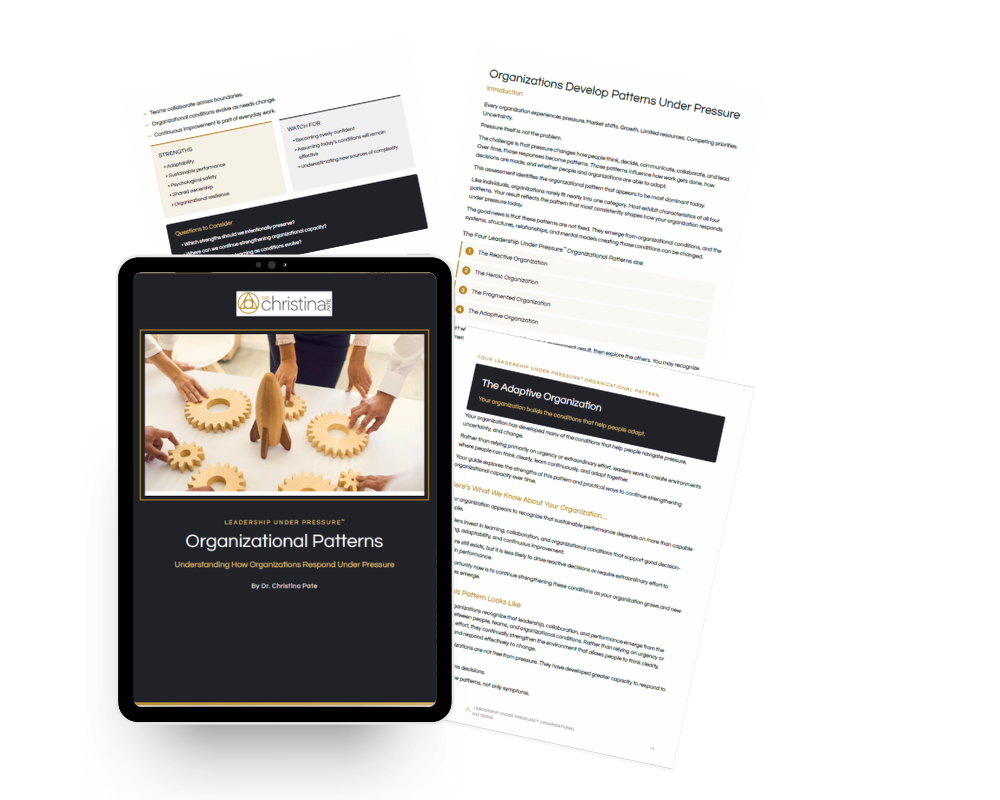
The Organization. This is the level most leadership development skips entirely, and it's often where the real leverage lives. The structural conditions shaping daily work, decision rights, communication norms, workload distribution, role clarity, cross-functional relationships, aren't just context. They are variables that either support or undermine everything the first two levels are trying to build.
Mapping those conditions clearly, naming what's within a leader's control versus what's within their influence versus what belongs to the system, is one of the most practically useful things a leader can do. And it's one of the things most leaders have never been given structured support to do.
What Effective Leaders Do Differently
The leaders who navigate organizational complexity without burning out share some identifiable patterns. They are deliberate about where they invest energy rather than distributing it across every friction point that appears. They protect their capacity as a strategic resource, recognizing that a leader who has absorbed too much pressure becomes less effective precisely when their team needs them most.
They build influence through strategic communication rather than through volume or persistence. They establish clear boundaries around what they will carry and what they will name as belonging to the system. They stop trying to win every battle and become more precise about which battles actually matter.
And perhaps most importantly, they develop an accurate map of what's theirs to own, what's theirs to influence, and where their energy is going that it doesn't need to go.
That map is rarely something a leader can build alone, in the middle of the pressure that makes it hard to see clearly. But with the right structure and support, it becomes the foundation for a different kind of leadership, one that is more strategic, more sustainable, and more effective at protecting the culture that's already been built.
The Real Goal
The most effective leaders aren't the ones who manage to eliminate uncertainty or override the systems around them through sheer force of will. They are the ones who create enough steadiness, clarity, and alignment that uncertainty stops destabilizing everything within their reach.
That requires working at all three levels, starting with the leader and moving outward. It requires distinguishing between what leadership development can solve and what organizational design needs to address. It also requires being honest about the difference between a capability problem and a capacity problem, and between both of those and a conditions problem.
Leadership is not only about developing better leaders. It's also about creating the conditions that allow leadership to work.
A Few Questions Worth Sitting With
If anything in this post described your current experience, these questions are a useful place to start.
- Where are you carrying responsibility without the authority that should accompany it?
- What pressures are shaping your leadership right now, and how is that pressure changing the way you show up?
- Which challenges genuinely belong to you, and which ones belong to the system you're operating inside?
The answers often clarify the next move. Sometimes it's building capability. Sometimes it's expanding capacity. Sometimes it's naming the organizational conditions clearly enough to actually do something about them.
That distinction is worth knowing before deciding where to focus next.
If you'd like to think through where the highest-leverage work is for you right now, I'd welcome that conversation. Request a consultation.
And if you're already clear that you're ready for sustained support, the Leadership Under Pressure Lab is currently accepting applicants for the next season/quarter. Inquire through the contact page!