Why High Performers Suddenly Burn Out: What Leaders Miss About Human Capacity at Work

Your electric toothbrush doesn't die all at once. It works perfectly for days, then weeks. Then it starts feeling a little weaker. Maybe it hesitates. Maybe it sounds different. You keep using it because it's still working, still doing the job, still getting you out the door in the morning. Then one day it simply stops.
Batteries don’t fail suddenly. The depletion has been happening long before anyone notices. The final moment of failure is just the last step in a process that started much earlier.
People work the same way.
Why High Performers Don’t See Burnout Coming
High performers are particularly difficult to read on this front, and that difficulty cuts in both directions. They compensate well. Their experience gives them tools for managing outputs even when the internal resources that power those outputs are running low.
They've learned over years, sometimes decades, how to produce results under pressure, and that competence can mask what’s actually happening with their physiology.
The nervous system adapts to chronic activation. When sustained pressure becomes the baseline, the body recalibrates what "normal" feels like. Fatigue becomes the new resting state. The cognitive and emotional costs of performing under pressure become invisible because they've been present for so long.
High performers often borrow from tomorrow's energy to meet today's demands, and because they're skilled at doing this, the borrowing goes unnoticed until the account is genuinely overdrawn.
This is where awareness becomes a prerequisite for everything else. If a person can’t recognize depletion while it's happening, they have no opportunity to respond to it. In the context of sustained performance, awareness isn't a soft skill, but a survival skill.
Performance Declines Long Before People Burn Out
The metaphor of a battery is useful here, but it's worth being precise about what the battery actually powers. Human capacity isn't simply energy in the colloquial sense. Capacity underlies executive function, emotional regulation, creativity, learning, empathy, judgment, decision-making, and the quality of collaboration.
These aren’t optional features of leadership. They're actually the core outputs leaders are expected to produce, especially in complex, high-stakes environments.
What tends to happen under chronic pressure is that the work still gets done, at least for a while. Deliverables still arrive. Meetings still happen. Leaders still show up. However, the quality of what happens in those meetings, the soundness of the decisions, the relational nature of the interactions, the depth of the creative thinking, all of it begins to change.
The outputs look similar on the surface, but the capacity that produced them has been gradually eroding for months.
This pattern matters because organizations tend to measure outcomes, not the capacity that generates them. By the time outcomes begin visibly declining, the depletion has been underway for a long time.
The Workplace Often Prevents People From Recharging
Here’s where the conversation has to shift, because the most important question about burnout isn't why employees aren’t recovering. The more useful question is what conditions are making recovery structurally difficult or nearly impossible.
Consider what a typical high-pressure work environment actually looks like. It’s constant interruptions that fracture concentration, workloads that exceed reasonable human throughput, priorities that shift faster than people can orient to them, insufficient autonomy over how and when work gets done, chronic ambiguity about roles and expectations, the absence of psychological safety, emotional labor that is unacknowledged and uncompensated, poor or inconsistent leadership support, and always-on expectations that effectively eliminate the boundaries between work and rest.
Whew!
These aren’t simply inconveniences or cultural quirks. Researchers and occupational health bodies around the world now recognize them as psychosocial hazards, a specific category of workplace risk with documented effects on health, cognition, and organizational performance.
What Are Psychosocial Hazards at Work?
Psychosocial hazards are aspects of work design, organizational structure, management practices, and social dynamics that have the potential to cause psychological harm. They include things like job demands that exceed capacity, low job control, inadequate support from leaders and colleagues, role ambiguity, exposure to conflict or incivility, and environments where people don't feel safe speaking up.
The science on this has moved well beyond the realm of individual wellness. Countries including Australia and Canada have codified requirements for organizations to identify and actively manage psychosocial hazards with the same rigor applied to physical workplace safety. The international standard ISO 45003, developed under the broader ISO 45001 occupational health and safety framework, provides guidance specifically on managing psychological health and safety at work.
For leaders operating in organizational health, HR, or people strategy, this represents a significant shift. The conversation has moved from "how do we support employees who are struggling" to "how do we design work conditions that protect psychological health and enable people to sustain performance over time." These are fundamentally different questions, and they call for fundamentally different answers.
Why Recovery Is an Organizational Capability
Recovery tends to get framed as a personal responsibility. Take a vacation. Meditate. Set better boundaries. Sleep more. This framing isn't wrong exactly, but it's incomplete in a way that matters enormously at scale.
Recovery is also infrastructure. At the organizational level, recovery is the set of conditions that allow human capacity to be restored rather than continually spent.
It shows up in how leaders run meetings, how teams protect focused work time, how decision load is distributed across a system, whether psychological safety exists at a team level so people can raise concerns before they become crises, how workloads are managed across peaks and valleys, and whether AI tools are being used to reduce cognitive load or inadvertently increase it by generating more outputs for humans to process and respond to.
When organizations treat recovery as purely an individual matter, they're essentially asking people to refuel a car while the engine is still running and the vehicle is still moving. The mechanism of restoration requires conditions that make restoration possible.
Creating those conditions is a leadership and design problem, not a personal discipline problem.
The Leadership Under Pressure Lens
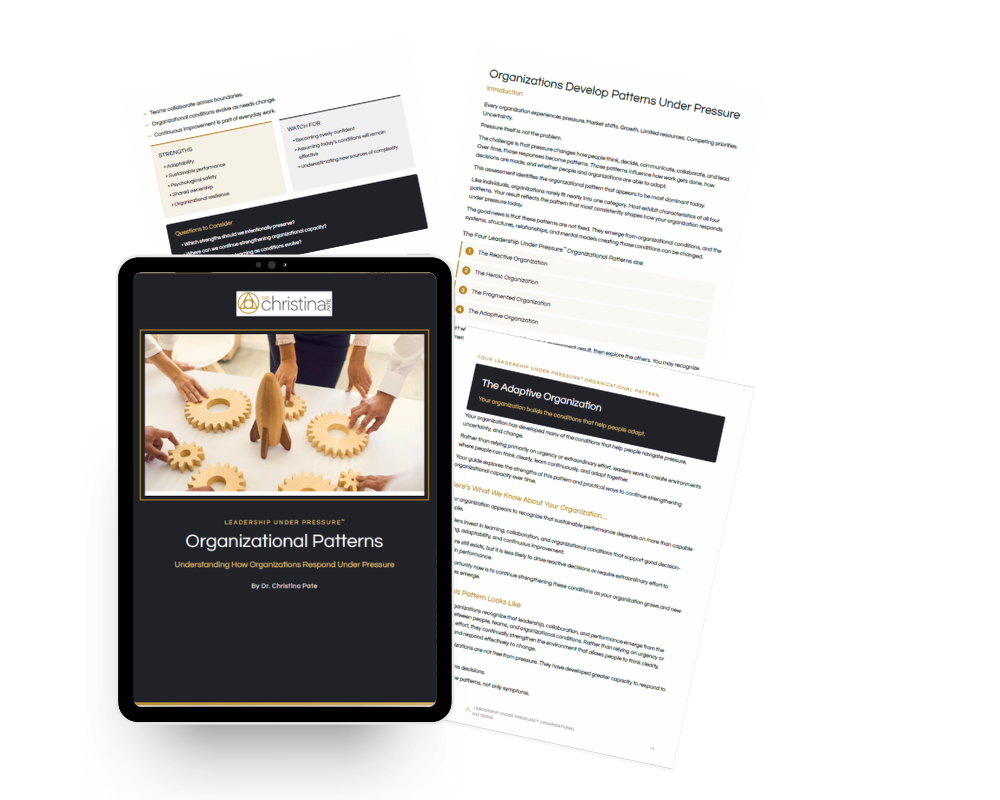
The Leadership Under Pressure™ framework is built on a foundational premise: performance isn't an individual phenomenon. It emerges from the interaction between the person, the team, and the organization.
Those three levels are not independent of each other. They shape one another continuously, and they collectively determine what leaders are actually able to produce when the pressure is high and the stakes are real.
Individual resilience matters. So do the conditions in which that resilience is being tested. Both shape how leaders think, communicate, build relationships, and make decisions when they're operating under sustained pressure.
The field of organizational health has spent decades trying to address these levels separately, and the evidence suggests that addressing them separately is insufficient.
ALCHEMI™ represents the internal side of this equation. Organizations have both the responsibility and the leverage to shape external conditions. Leaders and the people they lead can simultaneously build internal capacity, the kind of physiological and psychological capacity that changes how pressure is experienced, processed, and responded to.
Sustainable performance at any level requires attending to both.
Early Warning Signs Leaders Should Never Ignore
One of the most searched questions in this space is some version of "how do I know if someone on my team is burning out." The answer is rarely a single dramatic signal. Depletion tends to show itself gradually and through patterns that are easy to rationalize away.
Here are some “watch-for’s”:
- Increasing irritability or a shortened tolerance for ambiguity and difference
- Slower decision-making, where someone who usually moves with confidence starts hedging or deferring
- Reduced creativity or initiative, the absence of the generative energy that used to show up reliably in that person
- More conflict or, conversely, more emotional withdrawal, where someone who was once engaged starts going through the motions
- Presenteeism, the phenomenon of being present in body while effectively absent in mind
- Mistakes that are out of character
- Forgetting that is becoming a pattern
- Cynicism that has replaced the engagement that used to be visible
These signals invite a different kind of diagnostic question. Rather than asking what is wrong with this person, the more productive question is: what has this person's system been carrying, and for how long?
Sustainable Performance Requires Sustainable Conditions
Few of us wait until a battery is completely dead before we charge it. Or at least, most of us don’t do that intentionally more than once.
However, organizations do this with people more often than most leaders recognize. By the time someone burns out visibly, disengages, resigns, or makes a costly and consequential mistake, the warning signs have typically been present for months. The system was signaling long before the failure.
Building organizations where high performance is truly sustainable doesn't begin at the point of crisis. Instead, it begins with recognizing that human capacity is finite, that it depletes under sustained pressure, that it requires conditions that support restoration, and that those conditions are not automatically present in most high-performance environments. They have to be designed.
Recovery Built In, Not Bolted On
The best practice with rechargeable batteries isn't to run them to zero and then recover. It’s to recharge after each use, building restoration into the rhythm of use itself.
The same principle applies to human capacity at work. Recovery is most effective when it's woven into the structure of each workday, each week, each season of high demand, not reserved for the moment after someone has already hit the wall.
Prevention and recovery are not separate strategies. Prevention is recovery, applied early and consistently.
Human capacity is shaped by both our internal biology and psychology as well as the conditions in which we work. Attending to both is the work of modern leadership.
If you want to explore what this looks like in practice, the Leadership Under Pressure™ Masterclass on July 29 is a live introduction to the framework, including how to recognize depletion in yourself and your team before it becomes a performance problem.
If you’re ready to dive in, the LUP™ Profile & Strategy and the LUP™ Intensive for leaders is available.
If you’re interested in the Leadership Under Pressure Lab (group program) launching later this Fall, you can join the waitlist now to be the first to hear when registration opens.